Cracked Concrete Septic Tank? How to Tell If It's the Tank or the Baffle
October 13, 2026
Quick Answer: A crack in the tank wall and a damaged baffle can look alike from the surface, but they behave very differently. A wall or floor crack lets groundwater in or effluent out, so you tend to see a tank that stays too full, a soggy yard, or a tank that refills right after pumping. A failed baffle is a problem inside the tank. It lets solids and scum pass toward the drainfield, so you see slow drains, gurgling, backups, and an effluent filter that clogs again and again. The baffle usually fails first because it sits in the corrosive zone above the waterline. A pumping technician can tell you which one you have in a single visit with the tank empty and the lids open.
You pulled the lid, or the pumping crew did, and someone pointed a flashlight at the inside wall and said the words nobody wants to hear: "You've got a crack in there." Now you are standing in the yard in Kalamazoo, Portage, or Lawton wondering whether that means a failed tank, a cheap fix, or something in between. The honest answer is that the word crack covers a lot of ground, and the part that matters most is not the crack itself but where it sits and what it is letting through.
A concrete septic tank is really two things working together. The tank body holds the wastewater still long enough for solids to settle and scum to float. The baffles, one at the inlet and one at the outlet, manage how liquid enters and leaves so that the settling can happen. Damage to the body is a containment problem. Damage to a baffle is a separation problem. They call for different decisions, and mixing them up is how people end up replacing a sound tank or ignoring a failing baffle until the drainfield pays for it.
Pick ready mix when the concrete has to be one continuous piece tied into the ground. Footings, foundation walls, garage slabs, basement floors, and driveways all want a monolithic pour that bonds to rebar and the surrounding structure as a single unit. Custom shapes belong here too. If the geometry is one of a kind, no mold exists for it, so you place it wet and form it on site.
Large flatwork is the clearest case. A driveway in Van Buren County moving across an uneven base needs to be poured, screeded, and finished in one working window so you never get a cold joint where two pours meet and later split apart.
What the Tank Body and the Baffles Each Do
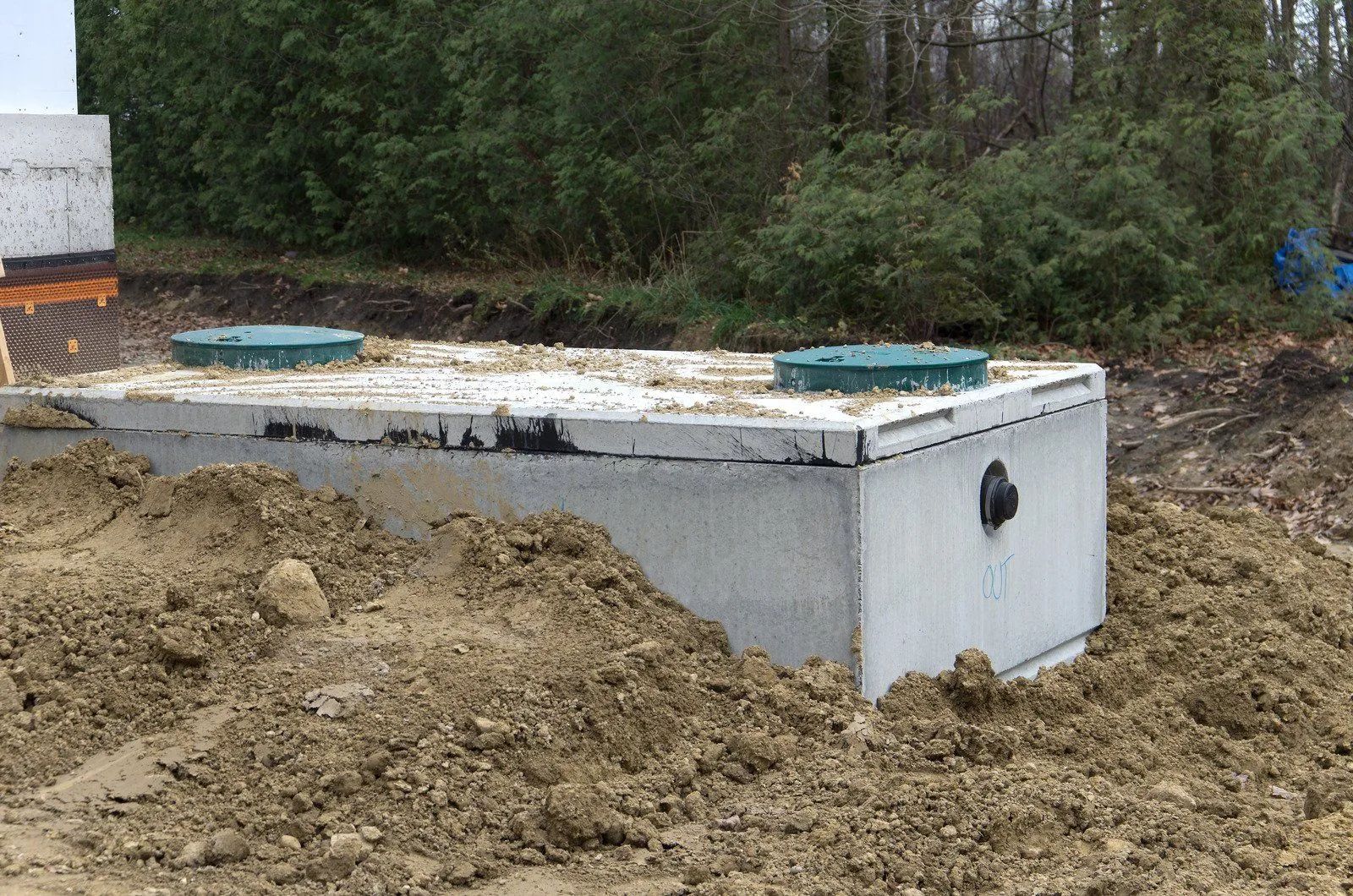
The tank body is the thick shell of reinforced concrete: walls, floor, and the top slab with its access openings. Its job is to stay watertight. Liquid should leave through the outlet pipe and nowhere else, and groundwater should not get in through the walls. Because concrete is rigid and heavy, the body does a good job resisting soil pressure and frost heave, which is a real advantage in a part of Michigan where the ground freezes deep every winter.
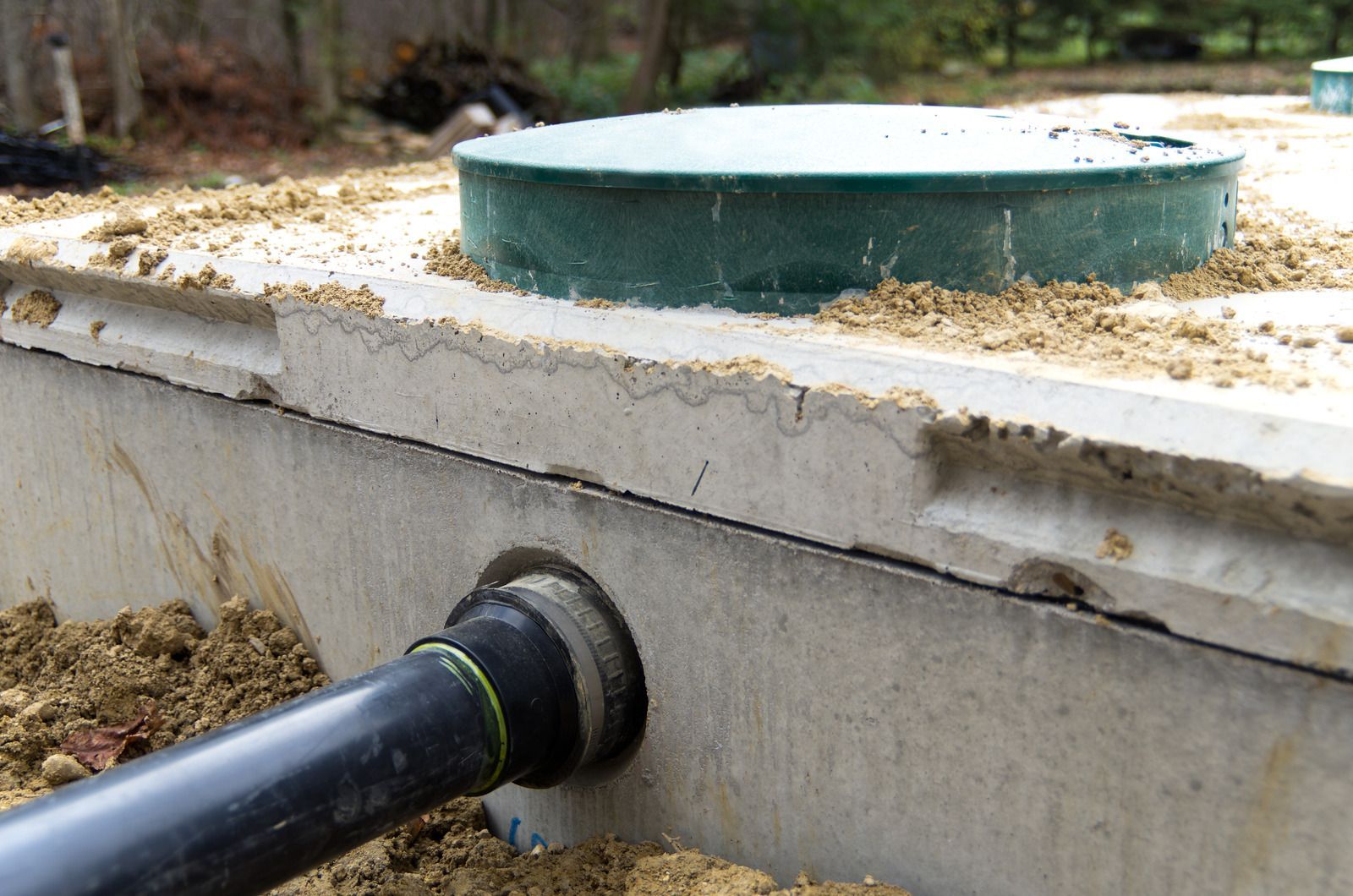
The inlet baffle is the fitting where household wastewater enters. It directs incoming flow downward so it does not stir up the settled layers or short circuit straight across to the outlet. The outlet baffle, often paired with an effluent filter, does the opposite job. It draws liquid from the middle clear zone of the tank and holds back the floating scum layer and the sludge below it. When the outlet baffle works, the liquid heading to your drainfield is relatively clear. When it fails, the tank can still hold water perfectly well while sending solids downstream.
Why This Distinction Matters
A tank body with a leak is a structural question. A baffle with a problem is usually a service question. Plenty of baffles are replaced with a sanitary tee fitting made of plastic pipe, a repair that leaves the concrete tank in place. A body that has lost its watertightness is a different conversation.
What Southwest Michigan Winters Do to the Decision
| Decision Factor | Ready Mix | Precast |
|---|---|---|
| Best for shape | Custom, monolithic, tied to rebar | Standard, repeatable units |
| Cure environment | Open air on your site | Controlled yard, steady conditions |
| Install speed | Days to gain strength before use | Set and ready fast |
| Site access need | Truck path plus washout area | Crane or boom plus firm ground |
| Weather sensitivity | High during the pour and cure | Low, cured before delivery |
| Quality consistency | Depends on field conditions | Uniform batch to batch |
Why Baffles Tend to Go First
If you could watch the inside of a septic tank for twenty years, you would notice that the damage rarely starts at the bottom or in the middle of the walls. It starts at the top, right where the baffles are. Wastewater bacteria produce hydrogen sulfide gas. In the damp air above the waterline, that gas combines with moisture and ends up as a weak sulfuric acid film on the concrete. That film slowly softens the surface, and the baffle is thin and sits right in that zone.
Ventilation makes a big difference. Gas is supposed to travel back up the inlet pipe and out through the house vent. If the inlet pipe was installed pointing slightly upward, or it pokes too far into the tank and its end gets caked with solids, gas has nowhere to go and lingers against the baffle. Tanks with that kind of installation problem often show heavy corrosion near the inlet and outlet while the rest of the interior still looks solid.
An old or badly mixed baffle can also simply deteriorate on its own. Industry inspectors who work on concrete tanks report finding baffles that have crumbled because the original concrete was weak or poorly cured, even when the tank walls are in decent shape. In a severe case the baffle looks eroded and crumbly, and rebar may even be exposed. At that point it is no longer separating anything.
What Southwest Michigan Winters Do to the Decision
| Decision Factor | Ready Mix | Precast |
|---|---|---|
| Best for shape | Custom, monolithic, tied to rebar | Standard, repeatable units |
| Cure environment | Open air on your site | Controlled yard, steady conditions |
| Install speed | Days to gain strength before use | Set and ready fast |
| Site access need | Truck path plus washout area | Crane or boom plus firm ground |
| Weather sensitivity | High during the pour and cure | Low, cured before delivery |
| Quality consistency | Depends on field conditions | Uniform batch to batch |
Signs the Problem Is the Tank Body
A true crack in a wall or floor shows up through what the water does, not through what the concrete looks like. These are the clues that point toward the shell.
The Liquid Level Is Wrong
A tank level above its outlet may indicate groundwater infiltration through cracks or joints. A dropping level below the outlet suggests effluent leakage.
It Refills Quickly After Pumping
If a tank refills within days despite unchanged household water use, groundwater infiltration may be occurring, especially after heavy rainfall or snowmelt.
You Can See Water Moving
Technicians may notice steady trickles or wet streaks inside an empty tank, particularly along walls or seams where separate sections meet.
The Yard Tells You Something
Wet, unusually green, or sunken ground near the tank itself may indicate leaking effluent, especially when the surrounding drainfield remains unaffected.
Not Every Crack Means Failure
Hairline concrete cracks may remain superficial. Concerning cracks penetrate walls, allow water movement, widen over time, or create displacement between adjoining concrete surfaces.
Tip:
Ask the technician to look at the tank right after it is pumped, with the lids open and the liquid level visible. An empty tank shows you the walls, the floor, the baffles, and any trickle of groundwater all at once, and it is the best moment to tell a shell problem from a baffle problem.
What Southwest Michigan Winters Do to the Decision
| Decision Factor | Ready Mix | Precast |
|---|---|---|
| Best for shape | Custom, monolithic, tied to rebar | Standard, repeatable units |
| Cure environment | Open air on your site | Controlled yard, steady conditions |
| Install speed | Days to gain strength before use | Set and ready fast |
| Site access need | Truck path plus washout area | Crane or boom plus firm ground |
| Weather sensitivity | High during the pour and cure | Low, cured before delivery |
| Quality consistency | Depends on field conditions | Uniform batch to batch |
Signs the Problem Is a Baffle
Because a failed baffle lets solids carry toward the drainfield, the symptoms show up in the house and around the effluent filter rather than in the tank wall.
Drains Run Slowly Or Gurgle
Blocked inlets or failed baffles can cause slow fixtures and gurgling sounds, even when the tank isn't full.
The Effluent Filter Keeps Clogging
Frequent filter cleaning may indicate solids escaping because a damaged outlet baffle no longer retains them properly.
Scum Or Sludge Is Reaching The Outlet
Thick scum near the outlet or solids entering outgoing pipes can indicate a failing baffle.
The Drainfield Is Struggling
Soggy ground or slow drainage may indicate solids bypassing the baffle and accumulating in the drainfield.
You See Crumbling Right At The Baffle
Soft, chalky, flaking concrete around the baffle often signals hydrogen sulfide corrosion rather than general tank deterioration.
What Southwest Michigan Winters Do to the Decision
| Decision Factor | Ready Mix | Precast |
|---|---|---|
| Best for shape | Custom, monolithic, tied to rebar | Standard, repeatable units |
| Cure environment | Open air on your site | Controlled yard, steady conditions |
| Install speed | Days to gain strength before use | Set and ready fast |
| Site access need | Truck path plus washout area | Crane or boom plus firm ground |
| Weather sensitivity | High during the pour and cure | Low, cured before delivery |
| Quality consistency | Depends on field conditions | Uniform batch to batch |
A Quick Way to Sort It Out
You do not need to be a technician to ask the right questions. When the tank is open, work through these in order.
First, Look At The Liquid Level
Check whether liquid reaches the outlet pipe. Unstable levels suggest possible shell damage.
Second, Look Where The Damage Sits
Damage near baffles suggests corrosion. Cracks extending downward may indicate shell failure.
Third, Check For Moving Water
Dampness differs from active leakage. Visible trickling indicates a more serious problem.
Fourth, Check The Baffle Fitting Itself
Ensure the baffle remains intact, securely attached, and correctly positioned at its depth.
Fifth, Look At The Pattern In Your House
Slow drains suggest baffle trouble. Unstable tank levels point toward possible shell damage.
Warning:
Never climb into a septic tank to look for a crack. The gases inside, including hydrogen sulfide, can overcome a person in seconds, and the same gas has claimed would be rescuers. Look from the opening with a flashlight, or have a trained technician do the inspection.
What Southwest Michigan Winters Do to the Decision
| Decision Factor | Ready Mix | Precast |
|---|---|---|
| Best for shape | Custom, monolithic, tied to rebar | Standard, repeatable units |
| Cure environment | Open air on your site | Controlled yard, steady conditions |
| Install speed | Days to gain strength before use | Set and ready fast |
| Site access need | Truck path plus washout area | Crane or boom plus firm ground |
| Weather sensitivity | High during the pour and cure | Low, cured before delivery |
| Quality consistency | Depends on field conditions | Uniform batch to batch |
What Usually Happens Next
If the verdict is a baffle, the repair is often modest and the tank stays in service. Technicians frequently replace a corroded outlet baffle with a sanitary tee and plastic piping, and they can reposition an inlet pipe that was angled wrong or extends too far into the tank. Just as important, they check that the vent path is open, because the same gas that destroyed one baffle will go after the replacement if it has nowhere to go.
If the verdict is the shell, the question becomes how bad the crack is. A small, dry crack that does not move water can sometimes be cleaned and sealed with a patching compound, although a surface treatment will not stop corrosion from the inside above the waterline. A crack that admits groundwater, a wall that has shifted, or a floor that has failed is usually beyond a patch, and it is time to talk about a replacement tank rather than a repair.
This is also where tank quality shows. A tank built with welded reinforcement, a dense mix, and a factory watertightness test starts with far more resistance to cracking and corrosion than a thin or poorly cured one. If you are replacing a tank, the details you cannot see after it is buried, such as wall thickness, rebar placement, and baffle design, are the ones that decide how long the next tank lasts. Concrete's weight also helps it stay put in high water tables and resist frost heave, which matters across the lower, wetter parts of Southwest Michigan.
Frequently Asked Questions
Is a cracked concrete septic tank always a failed tank?
No. Hairline surface cracks are common and often do not go through the wall. The ones that matter move water or are wide, widening, or offset. An empty tank reveals the difference.
How can I tell if my septic baffle is broken?
Watch for slow drains or gurgling, an effluent filter that clogs too often, and scum sitting at the outlet. Crumbling concrete or exposed rebar at the baffle is a sure sign.
Why do septic baffles crumble when the rest of the tank looks fine?
Baffles sit just above the waterline, where hydrogen sulfide gas turns into sulfuric acid on damp concrete. They are also thin. Poor venting and a weak original mix speed it up.
Can a broken baffle damage my drainfield?
Yes. When a baffle stops holding back scum and solids, they reach the drainfield and clog the soil. Drainfield damage appears slowly and costs far more than a baffle repair does.
Does a baffle repair mean I need a new tank?
Usually not. If the tank body is watertight and the walls are sound, a baffle can often be replaced and the tank kept in service. Replacement becomes the question when the shell leaks.
Why does my tank fill back up quickly after pumping?
A tank refilling within days, with no change in water use, may be taking in groundwater through a crack or bad joint. It is likelier after heavy rain or high water tables.
What Southwest Michigan Winters Do to the Decision
| Decision Factor | Ready Mix | Precast |
|---|---|---|
| Best for shape | Custom, monolithic, tied to rebar | Standard, repeatable units |
| Cure environment | Open air on your site | Controlled yard, steady conditions |
| Install speed | Days to gain strength before use | Set and ready fast |
| Site access need | Truck path plus washout area | Crane or boom plus firm ground |
| Weather sensitivity | High during the pour and cure | Low, cured before delivery |
| Quality consistency | Depends on field conditions | Uniform batch to batch |
A Crack Is a Symptom, Not a Verdict
A crack in a concrete septic tank is a symptom, not a verdict. Where it sits, what the liquid level is doing, and what your drains are telling you will point you toward the baffle or the shell, and that answer decides whether you need a small repair or a bigger decision. Get a look inside while the tank is empty, work through the questions in order, and you will know where you stand before anyone talks you into the wrong fix.
The part that outlasts every repair is the quality of the tank underneath it, since wall thickness, rebar placement, and baffle design are the details that decide how the next few decades go. Dave’s Concrete Products
has spent 41
years building reinforced septic tanks for properties around Lawton, MI, and the surrounding area, learning how deep frost and high water tables test a tank over time. That experience is what separates a tank you replace soon from one you forget about for years.